

STAINLESS STEEL INTRODUCTION
STAINLESS STEEL INTRODUCTION
Definition:
Steel containing more than 12% chromium that can resist chemical attacks.
Principle::
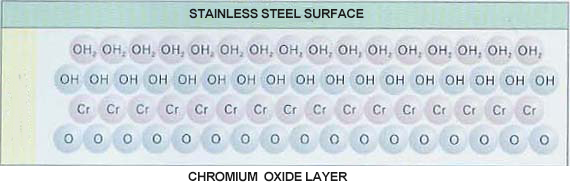
Stainless steel does not mean it won't rust, but rather it is resistant to rusting. The principle
involves the addition of chromium, which forms a dense chromium oxide layer on the surface of
the steel, effectively preventing further contact between the steel and air. This inhibits the entry
of oxygen from the air into the steel, thereby preventing rusting.
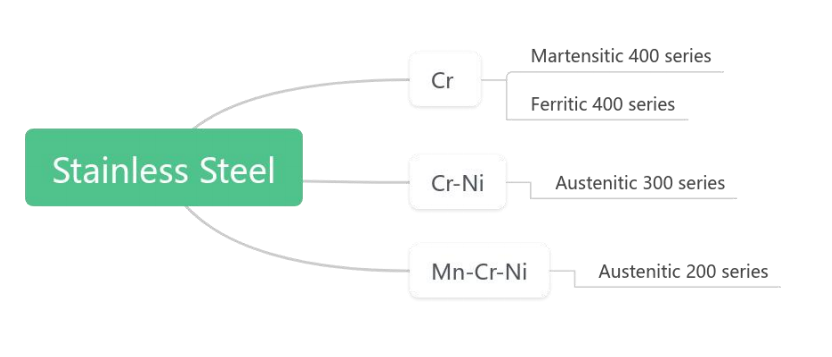
Chinese National Standards (CNS), Japanese Industrial Standards (JIS), and the American Iron and
Steel Institute (AISI) use three-digit numbers to represent different types of stainless steel, widely
referenced in the industry. The 200 series refers to chromium-nickel-manganese austenitic
stainless steel, while the 400 series refers to ferritic stainless steel (commonly known as stainless
iron), including martensitic and ferritic elements.
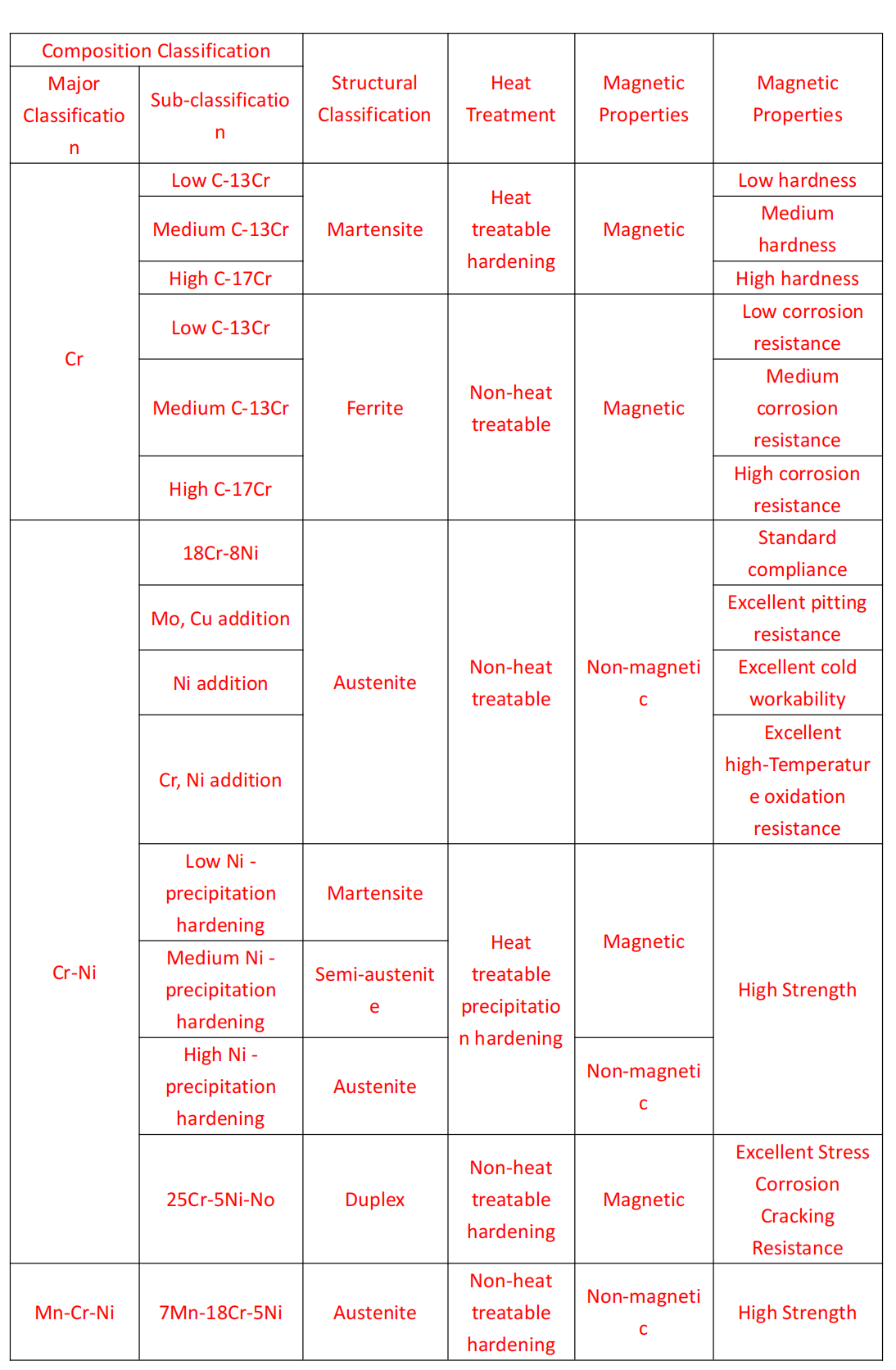
Additionally, classification can be based on composition, magnetism, ability to undergo heat
treatment hardening, and steel grade numbers, as shown in the table below::
|
Magnetism:
All austenitic stainless steel balls are typically non-magnetic; however, some magnetism may be
apparent after cold working. Standard: ISO3506 GB/T3098.6 Various materials' ability to be
magnetized. Applicable to stainless steel. Complete non-magnetism is only possible under
vacuum conditions. The measurement of the magnetic permeability of a material in a magnetic
field is relative to the material's magnetic permeability μr in a vacuum. If μr is close to 1, the
material has low magnetic permeability. For example: A2: μr ? 1.8, A4: μr ? 1.015, A4L μr ? 1.005, F1: μr ? 5.
The strength of magnetism is closely related to the alloy composition of the steel. The following is
the formula for calculating magnetism (smaller values indicate lower magnetism):
MD30 = 551-462×(C+N)-9.2×Si-8.1×Mn-13.7×Cr-29×(Ni+Cu)-18.5×Mo
Q&A:
Should I choose A2 or A4 stainless steel balls?
Answer: A) Prioritize choosing A2 (commonly known as 304) stainless steel balls, as they
generally satisfy most usage environments.
B) In environments with higher corrosive requirements, such as petrochemicals, chemicals, nuclear power, and coastal areas, consider using A4 (commonly known as 316)
stainless steel balls.
Copyright ? Copyright ? SHAOXING SHANGYU KEKE STAINLESS STEEL BALL MANUFACTURING CO., LTD. Address: Building 2, Building 3, No. 388 Guangyang Road, Songxia Street, Shangyu District, Shaoxing City, Zhejiang Province, China. Business Inquiry: 13905850076(Manager Yan) Phone: +86-0575-82674216 / 82673657 Fax: +86-0575-82679094 Email: scf7891@zjkeke.cn | 
|
 浙公網安備 33060402000318號